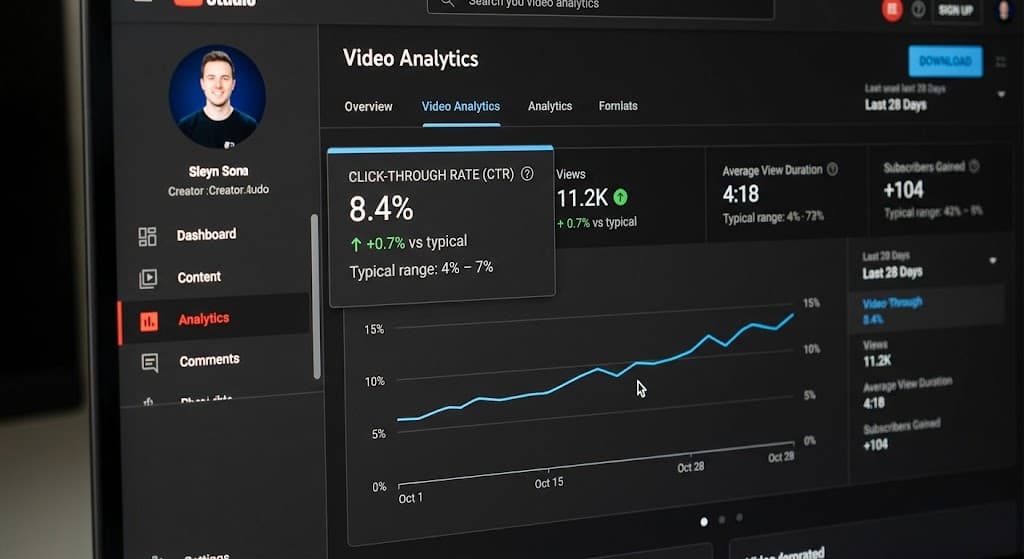
What's a good YouTube CTR? The honest answer is a range, not one number. Many "2026 benchmark" articles list exact percentages by niche, but they rarely say where the numbers come from. This guide sticks to what YouTube itself says, explains what really moves your baseline, and shows how to judge your own thumbnails without relying on someone else's spreadsheet.
What YouTube says about a good CTR
YouTube's own Help Center says that impressions click-through rate for most channels typically falls between 2% and 10%. That's the one benchmark from the platform itself, so it's the figure worth anchoring to. Check YouTube's current help page for the exact wording, since documentation gets updated.
Inside that range, creator blogs and tools often use a rough rule of thumb. It's a common convention, not an official YouTube figure:
- Below 2%: usually seen as weak. The thumbnail or title may not be earning the click.
- 4% to 6%: often described as a healthy average for an established channel.
- 8% to 10%: strong, and above most channels' baseline.
- 12% or more: excellent, and often limited to a channel's best videos.
Also note how new videos behave. A video often starts with a higher CTR because it's shown first to your subscribers, then settles lower as it reaches people who don't know you. A drop in the first few days isn't automatically a bad sign.
Does YouTube CTR vary by niche?
Probably, but there's no public, well-sourced dataset that shows by how much. Articles that list exact CTRs for gaming, finance, or tutorials often disagree with each other, and they rarely explain their sample or method. Treat any exact "niche benchmark" as unverified.
A more useful, directional idea: videos built on curiosity, such as a surprising result or an unanswered question, tend to earn more clicks than videos people search for with a clear task in mind, like a step-by-step tutorial. That's a behavior pattern, not a percentage, and it's more helpful when you design a thumbnail.
Two things that move your CTR more than niche
Channel size
Smaller channels often see higher CTR. Most of their impressions go to people who already follow them, and those people are likely to click. As a channel grows, more impressions come from people testing the video for the first time, which pulls the average down. If your CTR falls as you grow, this may be why, not a drop in thumbnail quality.
Traffic source
CTR from YouTube Search is often higher than from Browse or Suggested videos. A searcher has already typed what they want, and your thumbnail only has to confirm it's the right result. Someone scrolling the home feed needs more convincing. If more of your impressions come from Browse and Suggested, expect a lower overall CTR even if nothing about your thumbnails changed.
The benchmark that matters most: your own channel
Because size and traffic mix change your YouTube CTR, comparing yourself with a platform-wide average tells you less than comparing yourself with your own recent videos. Pull your last 10 to 15 uploads and compare their CTR side by side. A video well below your own average deserves a closer look. A video at or above it is doing its job, whatever an outside chart says.
Where to find your YouTube CTR
Open YouTube Studio, go to Analytics, then Reach. The "Impressions click-through rate" card shows your channel average and lets you see individual videos. Filter by date range and by traffic source to separate the effects above, instead of reading one blended number.
Don't chase CTR on its own
A thumbnail that gets clicks by misrepresenting the video can raise CTR while hurting retention. Viewers who feel misled leave quickly, and that hurts you later. The goal is a click the video can deliver on. If CTR rises while watch time falls, the thumbnail may be over-promising.
How to improve a low YouTube CTR
- Treat the thumbnail and title as one unit. The thumbnail creates a visual hook, and the title adds context. Repeating the same idea in both wastes space. See how a thumbnail and title work together.
- Fix readability first. Most weak thumbnails fail at small, low-contrast feed size. Check yours at phone size before changing anything else.
- Change one thing at a time. Swap the background, the text, or the expression, then measure. Changing everything tells you the new version is different, not why.
- Work through a checklist. Our 10-point diagnostic checklist covers the usual causes.
- Get a second opinion before you publish. Run your thumbnail through ThumbRoasty for a quick read on hierarchy, readability, and clickability.
If a live video is below your average, you can change the YouTube thumbnail and measure the difference, or run a proper A/B test.
Frequently asked questions
What's a good YouTube CTR for a new channel?
New, small channels often see higher CTR than established ones, sometimes above the 2% to 10% range YouTube mentions, because early impressions skew toward people who already follow you. Don't be discouraged if it drifts down as you grow. That's a normal shift.
Why did my CTR suddenly drop?
Common causes are more Browse and Suggested impressions compared with Search, a video moving past its first high-CTR days, or a real drop in thumbnail or title performance. Compare the video against your own recent average before assuming the worst.
Is there a verified CTR benchmark by niche?
Not one we can point to. Niche tables online often contradict each other and don't cite their data. The figure worth trusting is YouTube's own 2% to 10% range, and your own recent average.
Does CTR work differently for Shorts?
Yes, in practice. Shorts are viewed in a swipe feed, not a grid of thumbnails, so the first second of the video often works like the thumbnail. Track your Shorts and long-form CTR as separate baselines instead of mixing them.
The bottom line
A good YouTube CTR isn't a fixed number. It depends on your channel size and where your impressions come from. YouTube's 2% to 10% range is the one figure worth anchoring to, and your own recent average is the benchmark worth beating. When a video falls short, the fix is usually in the thumbnail and title working together.


